| www.padrak.com/breakthrough/BTP_BOOK.html | March 22, 2009 |
Breakthrough Power: How Quantum-leap New Energy Inventions Can Transform Our World
By Jeane Manning and Joel Garbon
Book Information Website
www.breakthroughpower.net
About the Book | The Authors | Audio/Video | Buy the Book | Media | Blog
Below:
Table of Contents
Preface
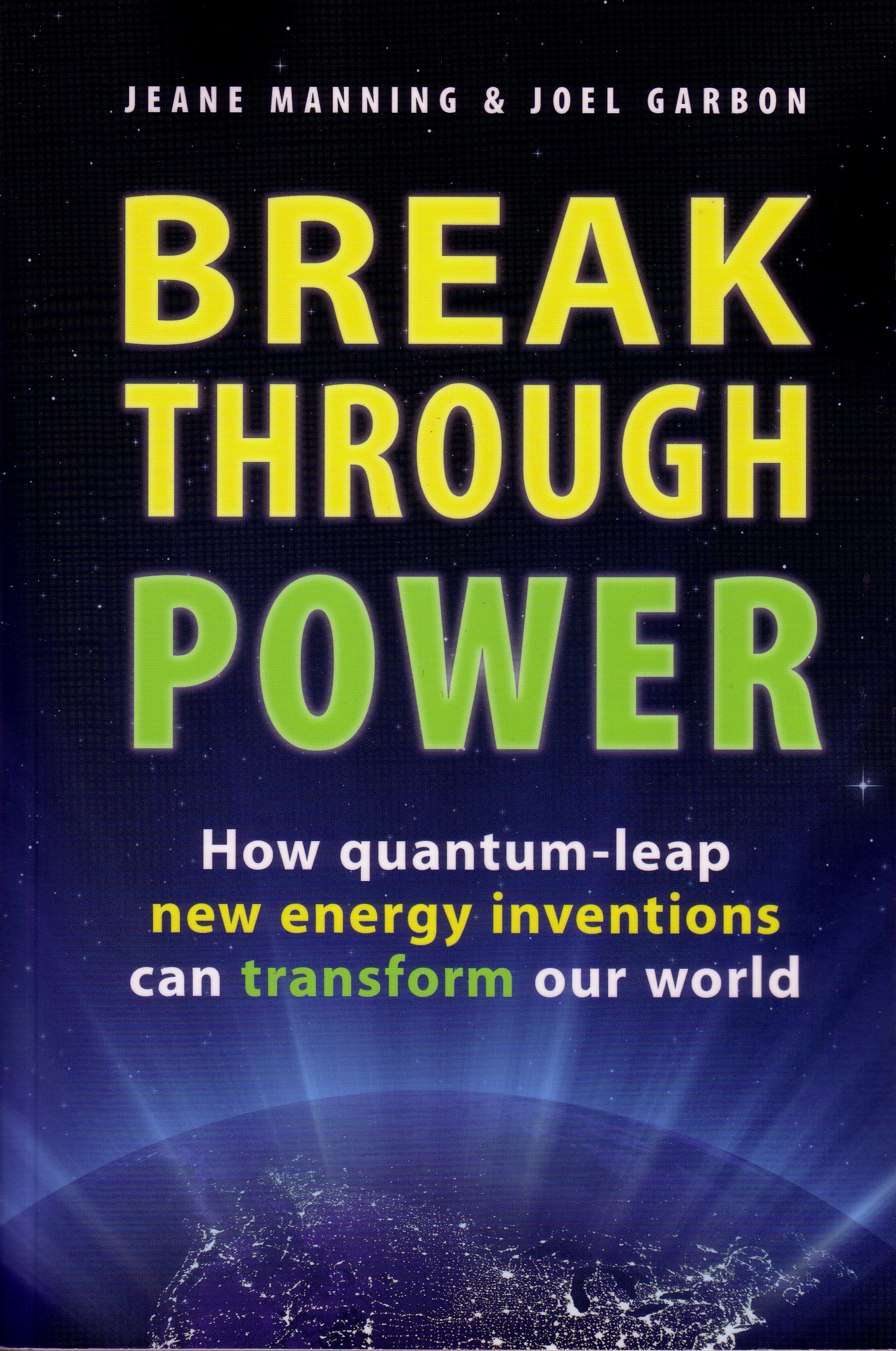
Front Cover
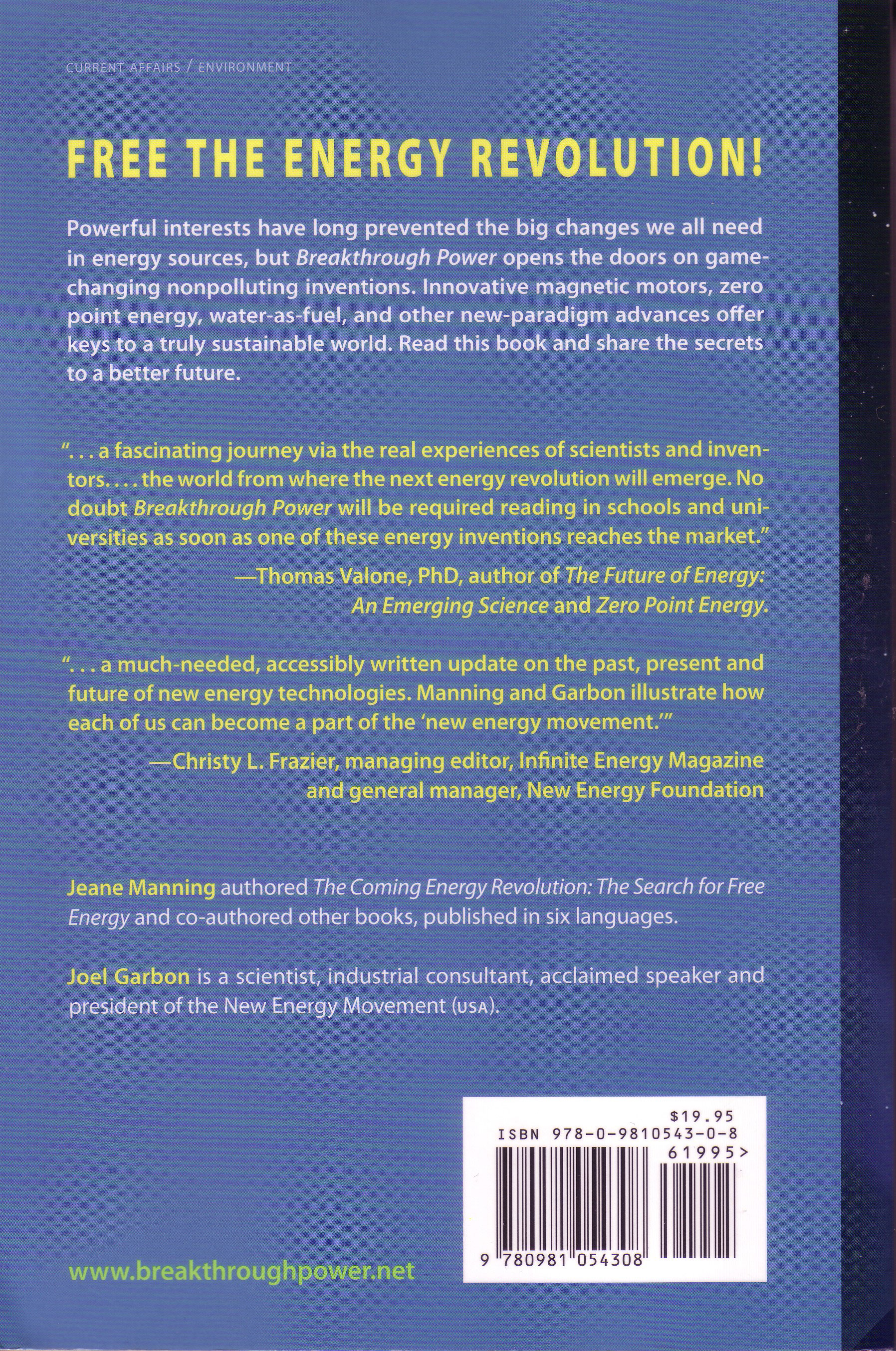
Back Cover
CONTENTS

Preface ...........................................  ix

Part I Wake-up Time ...............................   1
 1.  Jeane's Journey...............................   3
 2.  Reclaiming Decision-making ...................  17
 3.  Breakthroughs Needed..........................  28
 4.  The World We Can Choose.......................  42

Part II Hidden History Impacts You.................  53
 5.  Nikola Tesla .................................  54
 6.  Surging Sea of Energy.........................  65
 7.  Living Energy ................................  72
 8.  Power from the Universe ......................  82
 9.  Magnetic Pioneers.............................  92
10.  Oil and Water ................................ 106

Part III Emerging Era ............................. 117
11.  Breakthrough Theories ........................ 119
12.  The Water is Hot.............................. 134
13.  Better Than Fire ............................. 148
14.  Singing Water................................. 159
15.  Magnets in Your Future........................ 169
16.  Downpour of Solutions ........................ 176

Part IV Who Hijacked the Energy Revolution? ....... 187
17.  Misled Media.................................. 189
18.  Hitting the Wall ............................. 201

Part V You Can Help Reclaim Choice ................ 211
19.  Opening Doors ................................ 213
20.  What You Can Do............................... 226

Appendix 1 Energy Innovation Act................... 237
Appendix 2 Mohorn's Self-running Wall Dryer........ 243

Notes ............................................. 248
Resources.......................................... 259
Glossary .......................................... 261
About the Authors.................................. 264
Index ............................................. 266
PREFACE

The quantum-leap clean energy revolution has a much better chance than
it had a dozen years ago when Jeane Manning's book The Coming Energy
Revolution was published; conditions are different now:

* A fast-growing percentage of people are aware of atmospheric pollu-
tion from carbon fuels and at the same time are weary of oil wars.

* Many are worried about nuclear waste from power plants and those
facilities' vulnerability to terrorism.

* Scientists are concerned about the increasing acidity of oceans as the
waters soak up excess atmospheric carbon dioxide.

* Vehicle owners are increasingly alarmed and financially distressed
by the escalating price of fuel.

* People see the cost of corn-based food shoot up as a result of the
agribusiness race to sell "biofuels" that are based inappropriately on
corn.

* The Internet allows the global brain-trust of inventors, engineers,
other researchers and activists to make connections at a previously
impossible speed.

The push for an energy revolution

The result of that global brain-trust is an international effort to completely
change the sources of energy on which our world is based, and to tap into
a previously unrecognized background energy found everywhere. Some
of its proponents call it "free energy." Some call it "zero point energy." By
any name, it has the potential to affect the life of every human being on
Earth.

Background energy-another term we will use in this book-is real,
despite having been publicly confused with the old discredited idea of
perpetual motion. As with the earlier personal computer revolution, inven-
tors are making breakthroughs in home workshops and garages as well
as in professionally run laboratories. Observers of these developments
predict that this revolution will have more of an impact than Pes have
had. These inventions could do more than transform our homes, vehicles,
and factories; they could also help clean up the water, air, and soil.
The co-authors of this book have spent more than thirty years com-
bined in learning about energy-technology alternatives and what they
mean to society. Joel Garbon's career has been in industrial science, and
some of his colleagues hold the view that certain new energy systems
would violate a principal law of physics if the inventions work as claimed,
and therefore must not be real.

For instance, certain technologies are claimed to produce more mea-
surable output power in the form of electricity, heat, or mechanical power
than can be accounted for by the measurable input power. On the surface,
such a claim would be contrary to well-established laws of thermodynam-
ics, such as the law of conservation of energy.

However, Garbon and others have investigated such inventions and
have learned firsthand that many of these prototype devices do work as
claimed. So from a practical standpoint, they obviously must not violate
any real laws of nature. They may, however, violate some human-conceived
theories of nature. But the explanation for the unusually high power yields
may be even simpler. New detecting and measuring equipment may be
needed to understand what is happening in such machines, as we learn
in chapter II.

Tools for change

We're not promoting products; in general the products are not even on
the market. At the time of this writing you can't find a line of free-energy
converters for sale to replace the home-power generators on the market.
No auto salesroom displays an electric automobile powered by the cosmos.
No manufacturer advertises an Air-Cleansing Water-Fueled Truck.

That situation can and inevitably will change, because of breakthroughs
being made. For instance, a device has been successfully selling in Europe
to deal with moisture that creeps up walls inside stone-walled base-
ments. It cannot power household appliances, but does do useful work.
The Mohorn device (see Appendix 2) taps into a previously unrecognized
source of ubiquitous energy.

This book introduces new energy systems as tools for creating change,
not as a cure-all for human problems. Powerful tools require utmost respect.
You don't hand an electric drill to a child; you wait until the child matures
and is more responsible. However you do educate them along the way to
that time when they can handle and use the tool. Similarly, the human
family's general level of responsibility to all life is evolving, and perhaps
humankind will become more responsible as we face the environmental
crises caused by human actions-from actions of overfishing the oceans
to degrading the atmosphere with polluting toxins.

Who invents breakthroughs

Outside of secretive government or industrial laboratories, inventors in
this field have often been individuals without advanced scientific training,
working in small workshops. The standard scientific viewpoint has been that
these inventors didn't know what they were doing, that these new energy
sources cannot exist because they go against the known laws of physics.
In recent decades, however, some highly trained scientists have defied
that viewpoint and started taking new energy seriously. Around the world,
respected physicists are recognizing that official science has painted itself
into a corner. For too long, orthodoxy ignored mounting evidence in sup-
port of new energy. Now it seems as though the laws of physics will have
to be interpreted in a new way.

What's in it for non-techies

We're writing this book for people who are not necessarily technically
inclined, for the following reasons:

* Society's choices of energy technologies affect everyone.

* Voters need to know that oil wars are unnecessary.

* Youths need hope for a better future.

* The new science can promote world peace by uniting humankind in
the knowledge that all peoples are profoundly inter-connected in a
sea of energy.

* New Energy books aimed at technical experts do exist but other people
want simpler explanations such as those provided here. People deserve
to join the debates.

What to do with the knowledge?

If you are an opinion-molder or policy maker, this book can help you draw
up a citizens' map of a route to a better future. For instance, enviro-activ-
ists may see beyond a "sustainable" to a "restorative" economy in which
abundance of clean energy sources allows us to restore ecosystems and to
seriously clean the air, water and soils. And with energy literacy, citizen's
groups get the full picture of potential energy supplies.

If you are technically inclined, consider the clues pointing toward how
to create revolutionary energy systems, and explore the websites on the
starter Resources list at page 259. Teachers can give hope for the future
to students, and be motivated to encourage the science whiz to develop
his or her inventive talents.

If you are an economist, politician, social scientist, community leader
or are involved in national or regional planning, you will be able to help
create a new society where "disruptive" (disruptive only to the profits of
entrenched industries) inventions are allowed and are used for the bet-
terment of the people and all life.

If you serve elsewhere in society, you can help spread the word-telling
your friends, family and associates: "There are better ways to go. We don't
have to resign ourselves to a brutal future. We can each contribute to a
better world, if only by the power of positive thinking."

Meanwhile, of course, you can also be an example of walking-the-
talk environmentally. Many excellent books tell you how to reduce your
ecological "footprint".[1]

To picture the changes the new energy Galileos expect to bring about,
imagine yourself buying an enhanced energy converter about the size of
a laptop computer. This fuel-less device contains no moving parts, yet
it puts out enough power to run your home or your new electric vehicle
without being plugged into a wall socket or a battery. Since you no longer
have to pay a utility bill or buy gasoline, you have the money to lease or
purchase the converter. After the hardware is paid for, the electricity you
use is free. You can live anywhere, from a mountaintop to a houseboat,
because you can heat, air condition and power your home cheaply.

When can you buy a new-energy device? That depends on factors
discussed in this book. A lot of new-energy hardware is in the crude pre-
manufacturing stage-where the aerospace industry was in 1903 when
the Wright brothers flew their homemade aircraft for less than a minute
along a beach. However, collaboration and some substantial investment
could bring some of these inventions to store shelves soon. China, India,
Japan and a few other countries without oil wells-countries strongly
motivated to find new sources of energy-show the most interest in such
a team effort.

Skeptical

Is harnessing the energy of space an impossible dream and are its propo-
nents merely kooks, as new-energy debunkers would have you believe?
Are the guardians of official science correct to say it is impossible to run
machines on water, much less on energy from thin air? Such expectations
are reinforced when looking at some of the amateur literature of what
is called "fringe science". However, as the authors looked more deeply,
increasingly it did look as though it was possible to convert a previously
unrecognized energy source into useable power. Now the weight of evi-
dence has convinced us of the reality of useable new-energy inventions.

This book is intended to be a discussion-starter. Issues raised by the
prospect of cheap electrical power and decentralized sources of abundant,
clean energy, and other implications of this fascinating world should be
explored and discussed publicly. They are crucial to the economies of
countries, and to the well-being of individuals.

Lone inventors

The inventors you will meet in this book represent only a small portion
of the new-energy scene. While this book champions the lone inventors
and mavericks, we do not mean to underestimate contributions from
the worlds of academia, government, and business. These institutions,
though, are backed by well-financed public relations efforts. This book is
intended to balance the picture.

We relate the stories of these science renegades to not only explain
new-energy theories and devices, but to also show the harassment these
inventors have encountered. Our aim is not to arouse an "Ain't it awful"
reaction. Instead, we wish to draw public attention to the situation, in
the hope that public understanding will smooth the path of these energy
visionaries. We all have a stake in their success.

Even now, the winds of change are blowing through the smog of
our past ignorance. Many brilliant minds around the world are making
breakthroughs in revolutionary energy technologies by using a variety
of approaches. It's breakthrough time.